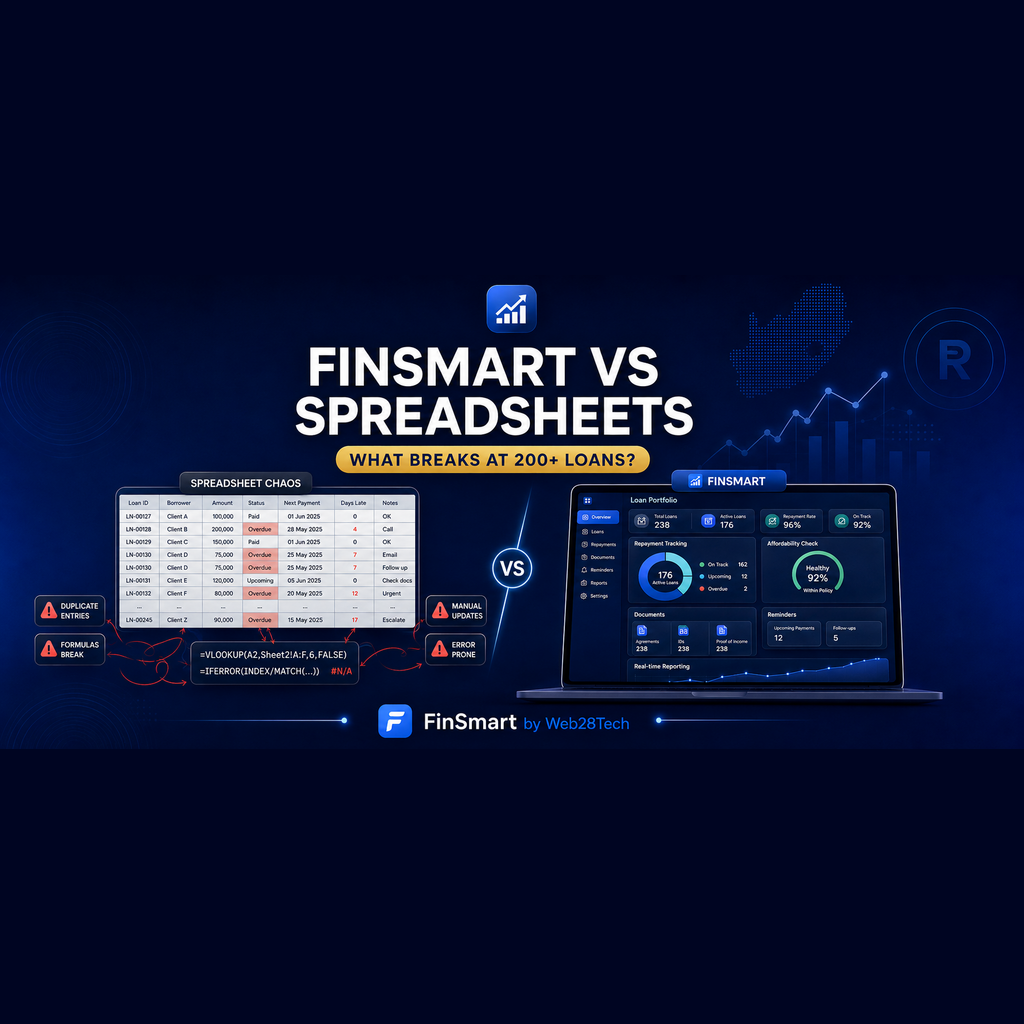
FinSmart vs Spreadsheets: What Breaks at 200+ Loans
Spreadsheets work fine for a handful of loans. Here's exactly where they start to fail — and what that failure actually costs a growing micro-lending business.
Most micro-lenders start on spreadsheets. It's free, familiar, and for the first 20–30 loans, it works. But growth exposes cracks that don't show up until it's too late to fix them quietly. Here's what tends to break, in the order lenders usually hit it.
1. Repayment Tracking Becomes a Full-Time Job
At 30 loans, tracking who's paid and who's overdue by eye is manageable. At 200+, it isn't. Someone ends up spending hours each week manually cross-checking bank statements against a spreadsheet, and mistakes creep in — a payment logged against the wrong client, a missed instalment that goes unnoticed for weeks.
What breaks: collection rate quietly drops, not because clients stop paying, but because the business stops noticing who hasn't.
2. Affordability Checks Get Skipped Under Pressure
Early on, every application gets a proper affordability review. As volume grows and time gets tighter, checks start getting shortened for "regular" clients or skipped for urgent requests. This isn't dishonesty — it's the natural result of manual process under load.
What breaks: inconsistent affordability assessments are one of the most common NCR compliance gaps, and they're invisible until an audit or dispute forces a review of historical records.
3. Documents Scatter Across Devices
Signed agreements end up in someone's email, a phone's photo gallery, a shared drive folder that isn't backed up. When a client disputes terms, or the NCR requests documentation, pulling together a complete record for one loan can take hours — and for a portfolio-wide audit, days.
What breaks: audit readiness. A spreadsheet tells you the numbers; it doesn't hold the paperwork.
4. Reminders Stop Being Consistent
At low volume, a WhatsApp message to a client due for payment is manageable to send by hand. At 200+ active loans, manual reminders either stop happening consistently or eat disproportionate staff time.
What breaks: collection rates and client relationships both suffer — clients who get inconsistent reminders are more likely to fall into avoidable default.
5. Reporting Takes Days Instead of Minutes
Monthly portfolio reviews, NCR submissions, or a simple "how are we doing this quarter" question all require someone to manually pull numbers together from multiple tabs and formulas that have grown unwieldy over time.
What breaks: decision-making speed. By the time the report is ready, the numbers are already a week old.
What Changes with Structured Software
FinSmart doesn't replace your judgment on lending decisions — it removes the manual points of failure that cause the issues above:
- Repayment schedules generate automatically and flag overdue accounts immediately
- Affordability checks are built into every application, applied consistently
- Documents and agreements are stored against each loan record, retrievable instantly
- SMS/WhatsApp reminders fire automatically, tied to each borrower's schedule
- Portfolio reports are available in real time, not rebuilt each month
The tipping point varies by lender, but most feel the strain somewhere between 100 and 250 active loans — right when growth should be a good problem, not a operational one.
Book a free demo to see how FinSmart handles the workflow spreadsheets can't.