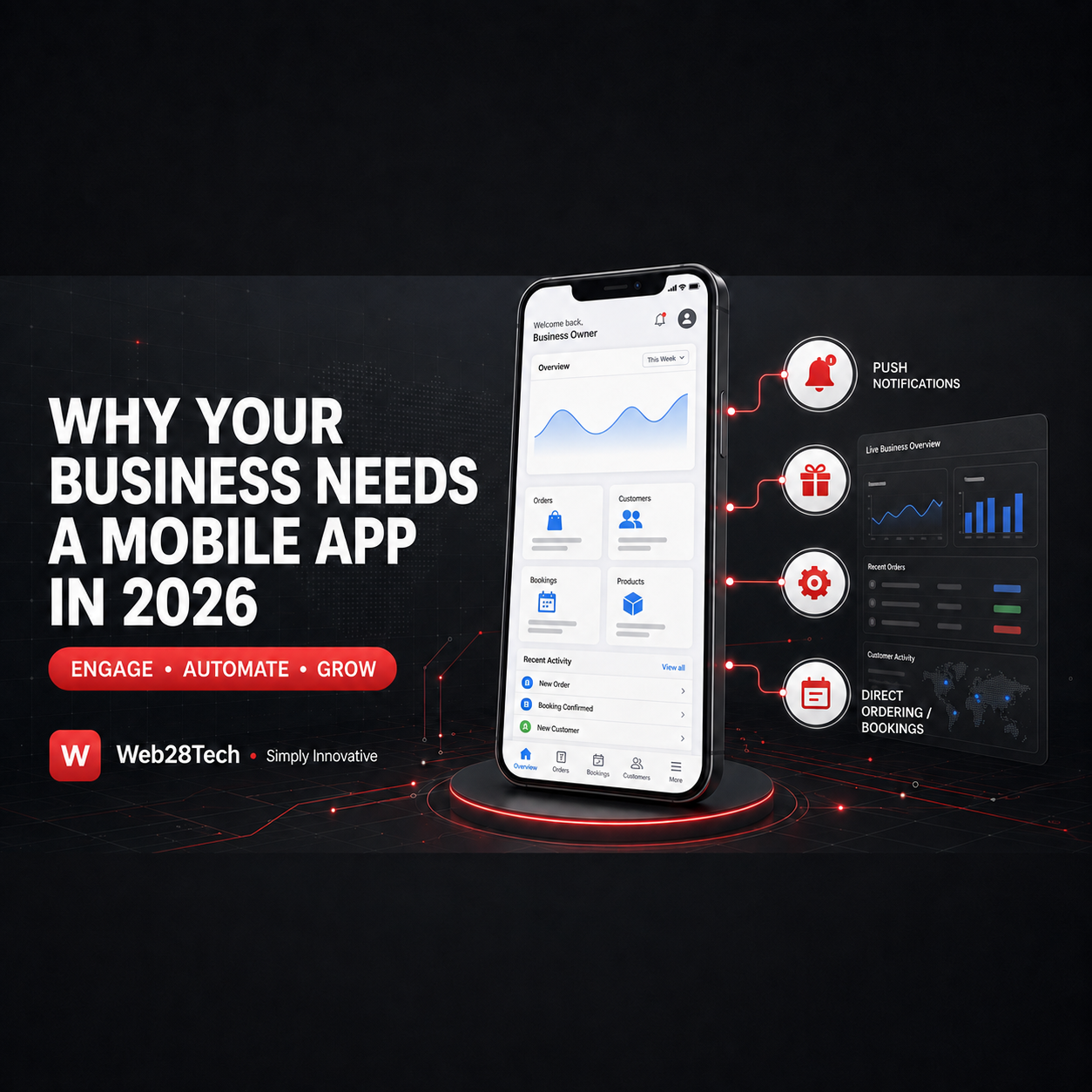
Why Your Business Needs a Mobile App in 2026
A direct line to your customers' pockets, available 24/7 — here's what a mobile app actually does for a growing business, and how to know if you're ready to build one.
In today's fast-paced digital world, having a mobile app isn't just a luxury — it's a tool that can reshape how customers experience your business. Mobile apps now account for the majority of consumer digital engagement, ahead of mobile browsers and desktop combined. For businesses that get it right, an app isn't just another channel — it's where customers spend their time by default.
Here's why that matters, what it can look like for your business, and what to consider before you build one.
Why Mobile Apps Matter for Business Growth
1. Enhanced Customer Engagement
Your customers are already on their phones. A mobile app puts your business where they already spend most of their screen time — not competing for attention in a crowded inbox or a feed, but sitting on their home screen. Push notifications, personalized content, and instant access to your services turn a one-time customer into a repeat one.
2. Stronger Brand Loyalty
A well-designed app creates a consistent, branded experience every time a customer opens it. Custom interfaces, loyalty programs, and saved preferences all deepen the relationship in a way a website visit rarely does — it becomes part of the customer's routine, not a one-off transaction.
3. Streamlined Business Operations
An app isn't only customer-facing. Order management, appointment scheduling, inventory visibility, and customer data collection can all run through the same platform — reducing manual admin and giving you a clearer picture of your business in real time.
Common Types of Business Apps
Not every business needs the same kind of app. Most fall into a few categories:
- Ordering & delivery apps — restaurants, retail, and food/grocery businesses managing direct sales
- Booking & scheduling apps — salons, clinics, consultants, and service providers managing appointments
- Loyalty & engagement apps — businesses focused on repeat visits and rewards-driven retention
- Operational/internal apps — field teams, logistics, or staff-facing tools that streamline internal processes
- Marketplace or service apps — connecting two sides of a transaction (providers and customers) within one platform
Knowing which category your idea falls into shapes both the build and the cost.
What This Can Look Like in Practice
Businesses that add well-designed mobile ordering, booking, or loyalty features commonly report measurable gains in order volume, average order value, and repeat-customer rate — the exact numbers vary widely by industry, execution, and how well the app is promoted to existing customers.
As we build out case studies with our own clients, we'll publish real, verified results here instead of industry averages — check back, or ask us directly about outcomes for businesses similar to yours.
What Affects the Cost of Building an App
There's no single price tag for "a mobile app" — cost depends on:
- Platform — iOS only, Android only, or both (cross-platform builds are usually more cost-effective than two native apps)
- Complexity — a simple booking app costs far less than one with payments, real-time tracking, or multi-user roles
- Backend requirements — apps that need custom servers, databases, or integrations (payments, SMS, third-party APIs) cost more than simple front-end apps
- Design depth — a fully custom interface takes longer than working from a proven, adaptable design system
- Ongoing maintenance — app stores update their requirements regularly; budget for updates, not just the initial build
The right first step isn't picking a budget in isolation — it's scoping what the app actually needs to do, then pricing against that.
Is Your Business Ready for an App?
An app makes sense if you're looking to:
- Streamline customer service and reduce repetitive support requests
- Open a new, direct revenue channel (ordering, bookings, subscriptions)
- Automate manual business processes
- Build a stronger, stickier relationship with existing customers
If any of these sound like where your business is headed, an app is worth a serious conversation — not because every business needs one, but because these are the problems apps solve well.
The Development Journey with Web28Tech
We keep the process structured so an app doesn't feel like an overwhelming undertaking:
- Discovery — We explore your idea, your customers, and your business goals
- Strategy — A clear roadmap: scope, timeline, and what success looks like
- Design — An interface built around how your customers will actually use it
- Development — Built with modern, maintainable technology
- Launch — Deployed, tested, and supported as you bring customers on board
Frequently Asked Questions
Do I need an app if I already have a website? Not always. Websites are better for one-off visits and broad discovery (search, sharing links). Apps are better for repeat engagement — customers who'll use your business regularly benefit most from an app; occasional visitors may be served well enough by a mobile-friendly website.
How long does it take to build a business app? It depends heavily on scope, but a well-defined app with a clear feature set typically moves from discovery to launch over a matter of months, not years. Simpler apps move faster; apps with custom backends or complex integrations take longer.
Do I need both an iOS and Android app? Most businesses do, since customers are split across both. Cross-platform development frameworks let you build once and deploy to both, which is usually more cost-effective than building two separate native apps.
What if I only have an idea, not a full spec? That's normal, and exactly what the discovery phase is for. Most businesses start with a problem to solve, not a finished blueprint — the strategy phase turns that into a scoped, buildable plan.
Ready to Talk Through Your Idea?
A custom mobile app is an investment in your business's future, not just a piece of software. If you've got an idea — even a rough one — it's worth a conversation before you assume it's too big, too small, or too complicated.
Contact Web28Tech for a free consultation, and let's talk through what a mobile app could look like for your business.